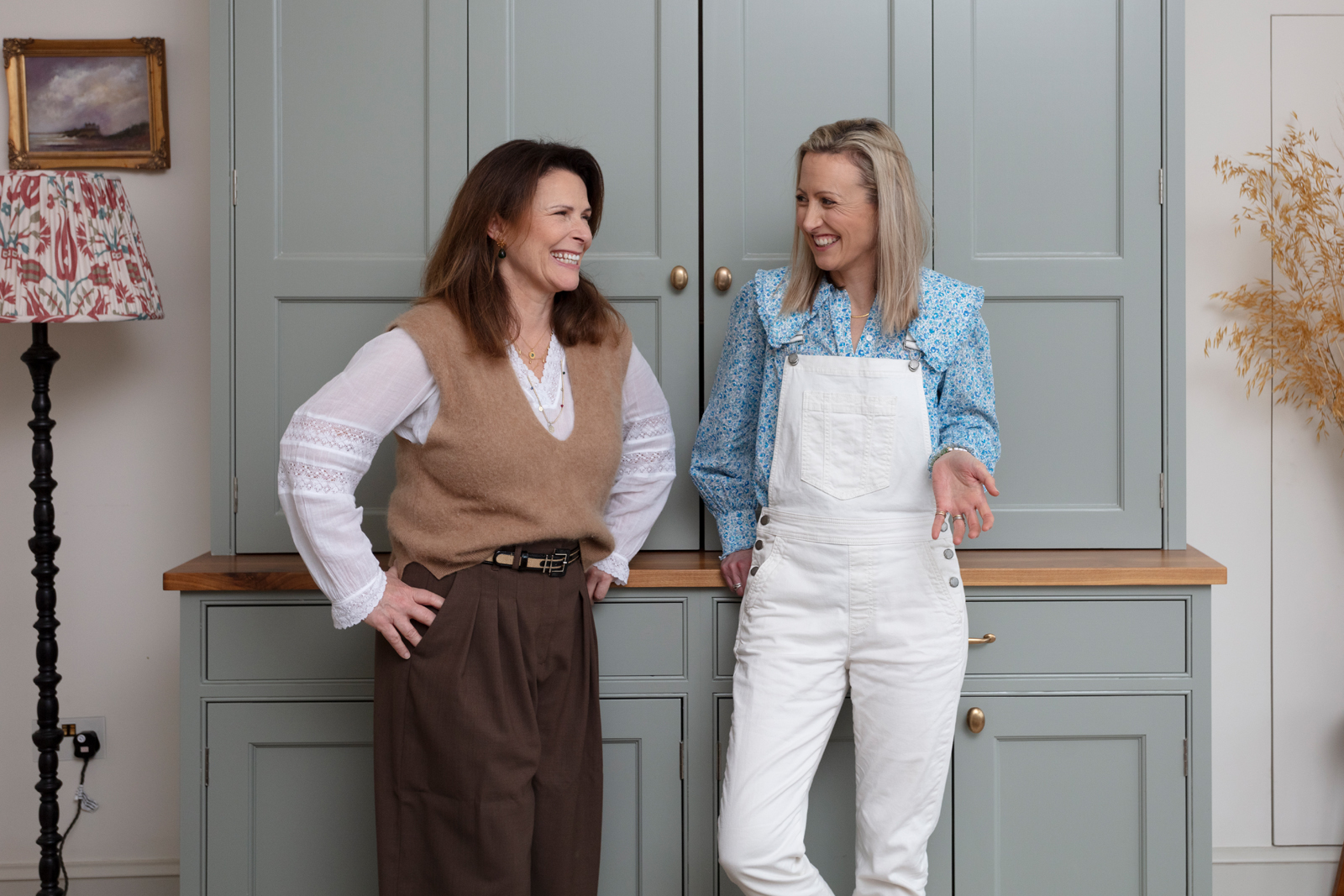
Monica Grose-Hodge on launching a new career as an artist in her 50’s.
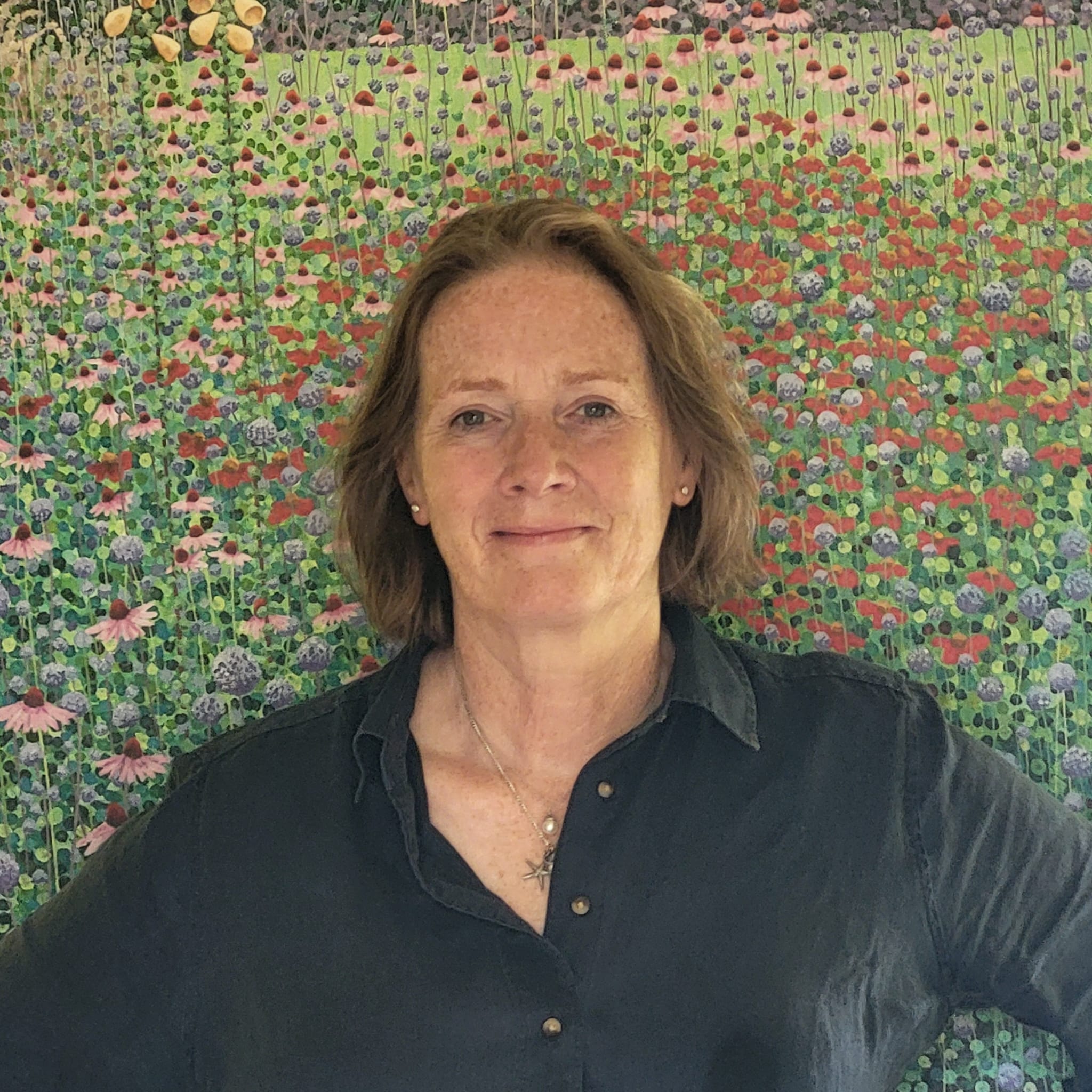
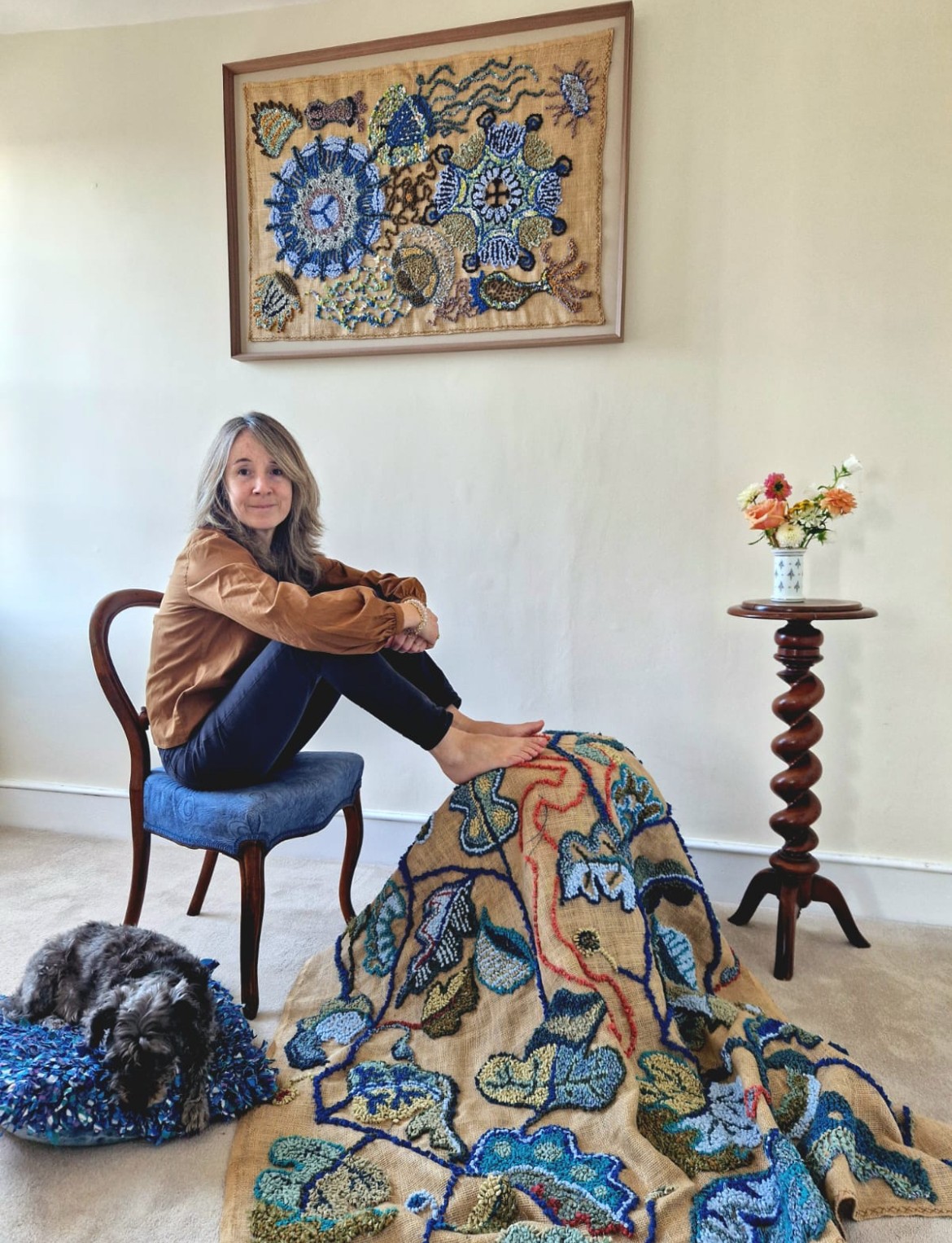
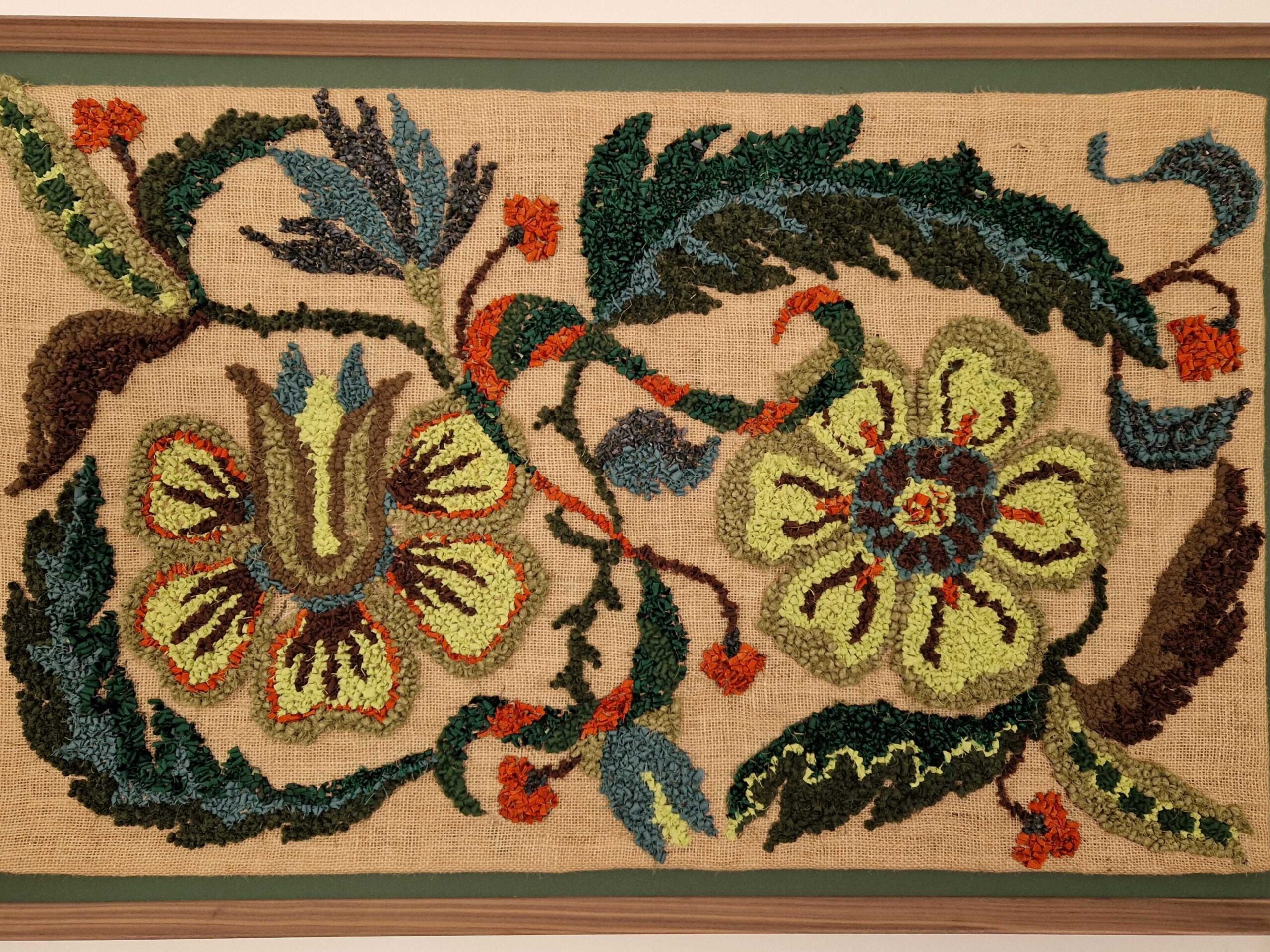
Artist Monica Grose-Hodge is an inspiration to anyone thinking of following their dream later in life. Sparked by the long, quiet days of lockdown and surrounded by boxes of old fabrics—gifts, heirlooms, and bits she couldn’t bring herself to discard—she began looking at crewel work and embroidery technique, experimenting with the almost forgotten textile tradition of rag rugging. What started as a creative diversion in her London flat quickly turned into something much bigger. Within a remarkably short time, her textured, storytelling pieces have caught the attention of leading interior designers and well-known actors, who now hang her work in their homes. Though she came to it later in life, she’s already built a devoted following and held just two exhibitions. Her work, often rich with memory and personal history, speaks not just to beauty but to the lives woven through the materials she uses. From a modest start during a global pause, Monica has stitched herself into the contemporary art conversation.
“Her textured, storytelling pieces have caught the attention of leading interior designers and well-known actors, who now hang her work in their homes.”
Tell us about your childhood and where you grew up.
My mother is Spanish from Andalucia and my father is English. I’m an expat child, so I grew up mainly in South America and in the Caribbean – in the Bahamas, and boarding school in the UK. I had a lovely happy childhood, always seeing wonderful things, deserts, jungle… but we moved every three or four years. Because of this my mother was good at throwing things out, whereas I wanted to hold on to things. I guess that because my environment was always changing I liked to collects bits and bobs along the way to treasure.
You only started exhibiting your work in 2024. What has been your career until now?
It’s quite patchy because my first degree was in languages at Edinburgh University. The other day my mother reminded me that I came out telling her that the only thing I knew for certain was I did not want to work in an office seven days a week for the rest of my life. I think I always had an eye on achieving quality of life.
So I went into publishing first because I did love fiction. And even though I am dyslexic and a slow reader, I loved it. I joined Penguin’s marketing department in the UK but obviously, as I was not able to spell, I wasn’t going to last very long there! I got a job in event management looking after VIPs at the 1992 Olympics and I really enjoyed that which led to me getting a job in New York doing something similar.
After 18 months, I missed the creative world so went back to publishing, this time working for the then CEO Peter Mayer (now deceased) at Overlook Press.
I lasted a year and a half which is longer than anyone else with him because he was a workaholic. He said to me… “Monica, you’re a terrible PA, not very organised, but you’re always taking photographs. You are wasting your time here. You need to go back to art school. So, bless him. I did. At the age of 30 I returned to London and embarked on another degree at London College of Printing (now London College of Communications), in surface design, which is a horrible name for printing. I learned all different kinds of printing and I got very quickly involved in wallpaper. I love large scale and I was particularly interested in flock wallpaper. Shortly after that, I joined the Wallpaper History Society and ended up being a trustee.
It was soon after that that I met Martha Armitage, who is a wonderful wallpaper designer whose work is characterized by hand-drawn designs that are hand printed from lino blocks. She was also just incredibly supportive and enthusiastic about my lino printing. What I really loved about printing is the three-dimensional element to it.
Now in my 30s with a mortgage, I couldn’t be an artist full time. So I ended up being assistant curator at Emery Walker’s House. Emery Walker was one of the leading lights in the arts and crafts movement and also a great friend of William Morris.
It was Martha and my friend from New York, the architect and interior designer Ben Pentreath, who told me about the job at The Artworkers’ Guild, which was a perfect part time job. When I arrived there were 200 members. There are now over 400. So there was a lot to do. I was the first person to bring a computer into the Guild. It was a listed building that needed a lot of attention. So it sucked me in. I ended up being full time Guild secretary for over ten years.
The office now has three people and a team of helpers; it’s great to see it flourishing. But I did my stint and I’m now an honorary member, which is lovely. On the one hand, I have met so much talent that it held me back. I thought, “how can I possibly produce anything worth showing”? But on the other hand, members have all been very supportive. Since I started making my rag rugs, they’ve been incredibly encouraging.
What was the tipping point that led you to make your first rag rug?
I’m very bad at sitting still. I’m a busy bee. I’m quite sociable. I like being out there and doing things so COVID forced me to slow down. And also, it made me look at what I could do within my tiny one bedroom flat! Printing was just too messy. A friend of mine suggested I try rag rugging. We had been talking a lot about recycling and the excess of textiles going to landfill. With rag rugging, it felt like I was doing a little bit of good by using up things that I would have otherwise thrown away or just left in a drawer forever. It could be my childhood clothes, an outfit I absolutely adored but is no longer wearable… I have even put my granny’s nightie into one of my pieces – in fact the one purchased by Georgie from Studio Cameron!
I’ve been very lucky. I’ve also been given some expensive pieces of fabric. Recently an interior designer passed away who was a friend of a friend of mine, and he had bags of beautiful silk material which I was given.
I have always been conscious of how older generations had a lot less in their houses and as such they valued clothes more. They mended them, they looked after them. And I think it is a shame that people don’t look at textiles and clothes in that way again.
Rag rugging came about from the attitude of ‘mend and make do’ which really appeals to me. There was a whole post war movement of getting women to make rag rugs, with the artist Winifred Nicholls starting a co-operative in the Lake District.
What inspires your designs??
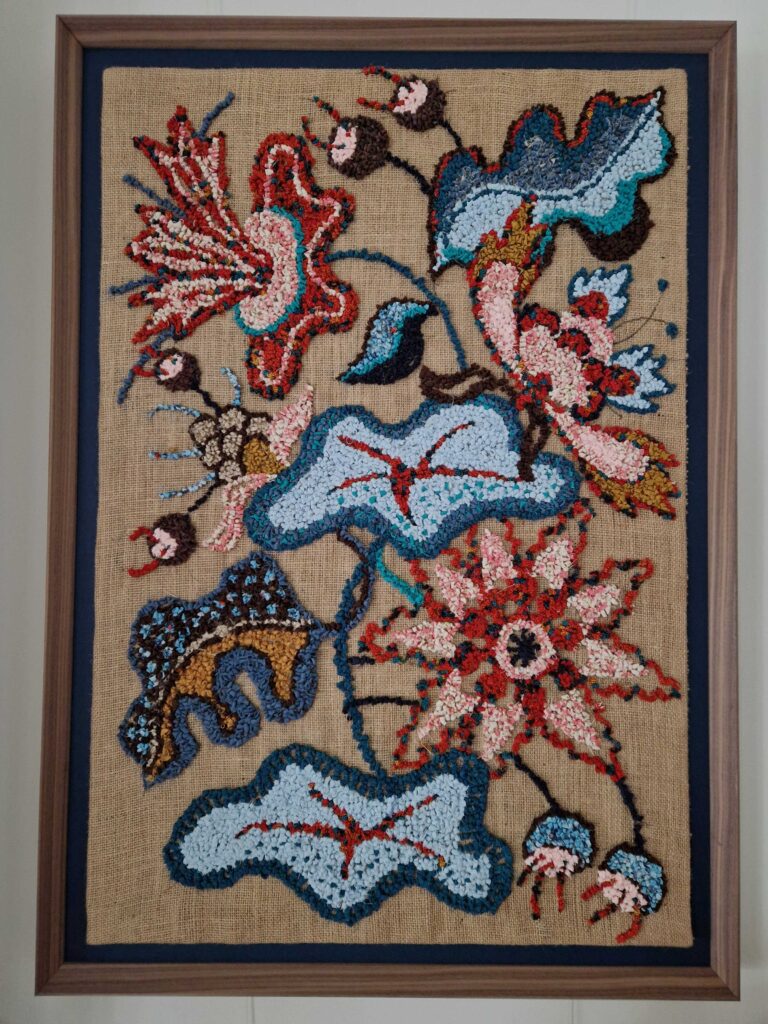
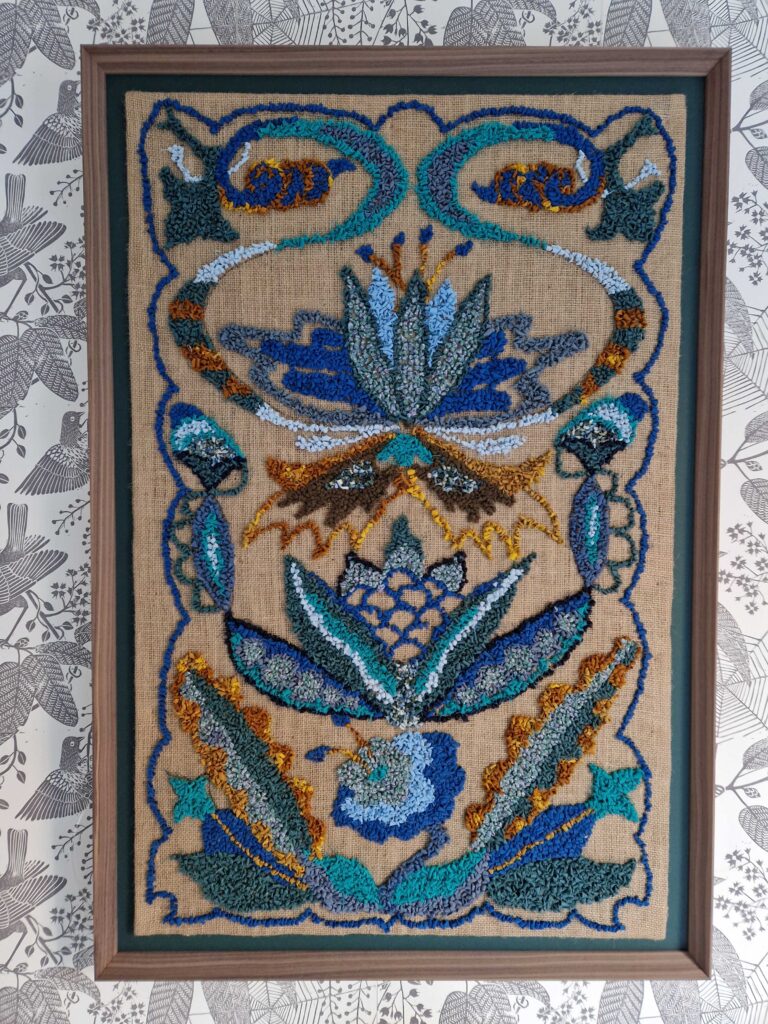
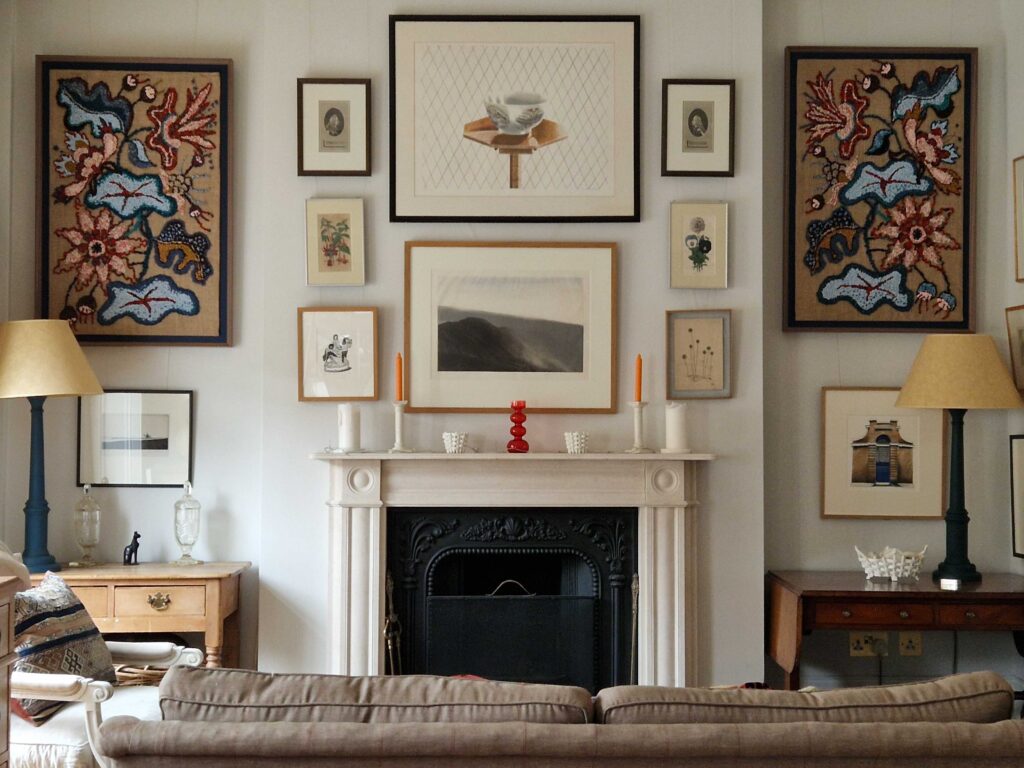
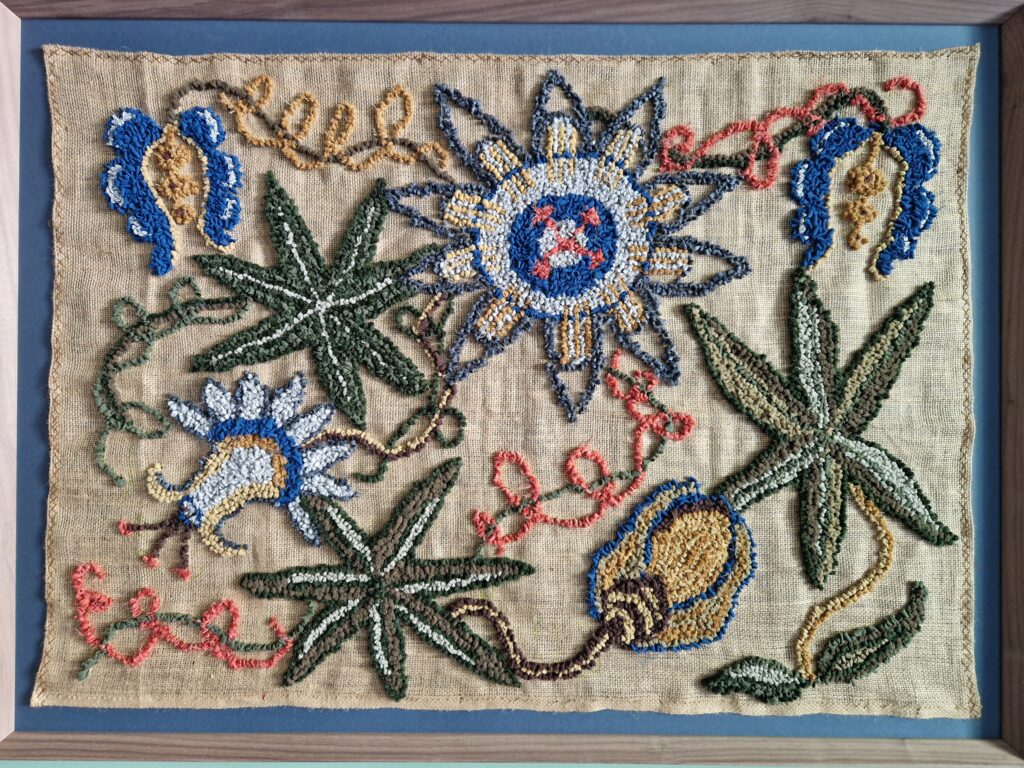
Nature has always been my main point of reference. And then I suppose people like Martha Armitage, and William Morris have inspired me. They are just so good. And then there is necessity. Because my mind is very active, I must have a clear theme for each exhibition of work to keep me focused. For the first one I looked at mediaeval embroidery from William Morris. I love mad foliage and the shapes are so childlike which is useful – if you’re doing embroidery with rags, there’s no finesse, so I think it needs to be bold and fun. My first exhibition was based on flowers.
For the next one I was thinking more about recycling and also the environment and I’m very passionate about the ocean and how that seems to be the Wild West right now. So the next set of works is themed around the ocean and include jellyfish, seaweed, coral, shells etc.
What is the process once you have your design idea?
I work with a small sketchbook of doodles, then I’ll turn them into repeats which make me think of space in a different way. I always like looking at repeats. And some of my pieces have been mirror imaged. Then I scale them up – drawing them on the hessian backing I will later embroider.
My work is slightly different from everybody else in that I don’t fill up the whole hessian background which gives it a more three-dimensional feel. I think people like it because it is unusual and it can be very bold in colour or it can be in pastels and quite gentle.
Your first exhibition was almost a complete sell out and you also received several commissions. Who buys your art?
I’ve been lucky that the people who seem to buy them are interior designers, art dealers and even one famous actress!
It probably reflects my interest in interior design and decorating. I’ve always loved curating space. When I started producing rag rugs they were for my apartment. I didn’t think I would sell them to begin with.
Who have been the major influences in your life and work?
I have so many!
Being at boarding school in the UK my guardians were a family called Patrick and Caroline Taylor. They had an eclectic home with Georgian, Indian and Chinese furniture. I thought it was a heaven. They also were big readers and their home was just full of interesting and beautiful things.
I also remember the impact of a trip I took around Spain in 2004. I won the Churchill Fellowship Grant and did a two-month trip interviewing craftsman all over Spain and it really opened my eyes to the diversity in styles throughout the Iberian peninsula, and its influence on South America. The national Andean costumes like the bowler hats and embroidered garments are all from Spain. I found that all very interesting. It has influenced my colour combinations.
Other key influences are my friends Ben Pentreath and William Smalley, who have very different styles. Ben is all about lots of beautiful objects and bright colours. William is all about material and texture and his work is very sparse.
There are many artists and crafts people I met during my tenure at the Artworkers Guild that I admire hugely. I have a long list. But (the wallpaper designer) Martha Armitage is right at the top. Martha was particularly influential, she is like my fairy godmother. I mean, she really did encourage me.
In 2023 I went to an exhibition at the Tate Modern by a Polish weaver called Magdalena Abakanowicz. She made these huge textile weaves. Things that were three-dimensional. I loved them and it had a huge impact on me.
I love the work of mid-century artists Mark Rothko and in England, Ravilious, Bawden and Nicholson, who were contemporaries of Moore.
House and Garden did a feature on your London apartment How would you describe your interior style at home?
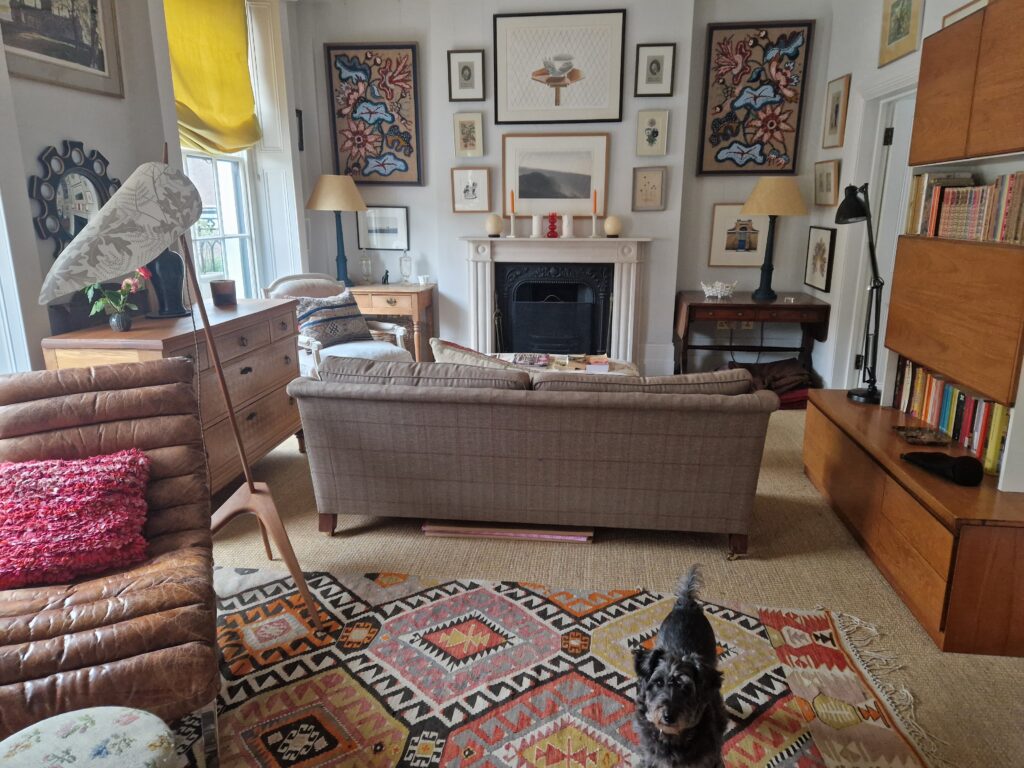
Very eclectic. I’ve collected over a long period of time. A lot of my pictures and things hanging on my wall and sculptures and ceramics are made by friends. Some things may not be valuable, but they are priceless to me. I am sentimental, not a collector. I think people need to be more confident in mixing things together so it’s not all one period. I have mid-century and Georgian. I would like to have a few more modern bits, but those are the most expensive.
What does a comfortable interior look and feel like for you?
A comfortable environment is one where I can see myself passing the time. So that means a comfortable chair with some lovely cushions and some things to look at. Layered with textures, textiles and books. I mean I can’t imagine a home without books, I’m uncomfortable when I go into a house and I can’t see a book. So you know those lovely coffee table books. I think those are all really important.
What advice can you give about using textiles in interiors?
Be brave. You can always change it. And if you really fall in love with a very expensive piece of fabric, then just buy a metre and turn it into a cushion. Just having that piece of fabric that’s ‘wow’ will make
you happy. So I think people should go for it. And if you are not keen on bright colours, just use a little for highlights.
What advice would you give to a young person starting out in a career in textiles?
Learn to sew, start embroidering. You can’t learn about fabrics unless you use them. And if you really love it then do a course. But it’s not easy to develop a career in textiles so do it for the love of it. And understand where fabrics come from and how they’re made.
What’s in the plan for this year?
I am busy working with commissions currently and am planning an exhibition in New York later this year.
If someone’s interested in buying one of your pieces or commissioning one, what’s the best way for them to do so?
Either message me via my Instagram account @monicagrosehodge or ping me an email mgh_nyc@hotmail.com. Re commissions, I am happy to work on them between September and February each year outside my busiest time preparing for my main exhibition. I have said to clients that if they want me to incorporate something that belongs to them or a relative, I am happy to do so. It makes it much more personal and makes a great present
Best Loved:
- Wall colour: Paris Grey by Sanderson. It’s a very warm grey.
- Fabric house: Zoffany. My lovely friend Peter is the head designer. Last year they came out with a really good collection called Indienne, which is all based on beautiful archival Indian fabrics. And I’ve always loved Indian fabrics. British design is hugely influenced by Indian hand printed fabrics.
- Artist /craftsperson: Rachel Matthews, an artist who has been really influential in constantly having the conversation about sustainability in urban environment.
- Cocktail: Wild By Tart’s Picante. I also love an a Sgroppino, unique to Venice.
- Hotel or bar for its interiors: The Wolsey.
- Restaurant: Living in New York and London, there are too many to choose from, but I’m trying one out tonight which I’m looking forward to called Omar in Borough Market. It’s got a great reputation.
- Cookbook: My mother’s – her recipes are the best.
- Favourite film: Room with a view by Merchant Ivory, The Florida Project by Sean Baker, or a Wes Anderson film.
- Book: Anna Karenina or something by Thomas Hardy.
- Travel destination: Either somewhere remote or a city destination with lots of culture.
- Fashion label: I am not into fashion. If you’ve got an eye you create your own fashion. It’s not about the label.
- Hero heroine: Wood-engraver and natural history author Thomas Bewick and an extraordinary female Baroque artist called Artemisia Gentileschi.
- Happy room: Anything with high ceilings and big windows that look out onto a beautiful view.